|

Origins...
|
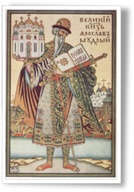 In
1010 Yaroslav the Wise, prince of Rostov, decides to safeguard the
borders of his domain and founds a small fort bearing his name. Grand
Duke sailed by shares of the Volga river and saw the tribe robing
merchant ships. Yaroslav went ashore but inhabitants incited Holy Bear
to him. Duke killed the bear and founded the city at place near
confluence of the Volga and Kotorosl rivers (this place is called
Strelka now)
To do so Yaroslavl had to conquer a pagan dwelling by slaying a bear,
the pagans' sacred beast. This story faded into a legend, but the
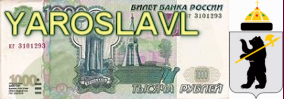
city's emblem still contains a silver shield with a bear holding a
golden pole-axe on it. In 1238 - The city had just begun to grow and
prosper when the bloodlusting hordes of the Mongol Empire swept through
the country, leaving behind them only ruins and stench of death.
Yaroslavl was not an exception. She was devastated and showed no signs
of revival during the long years of the Tatar yoke. Not until 1380,
when Yaroslavl's militia fought against the Mongols as a part of the
all-Russian host led by Dmitri Donskoy. In that battle the Russians
were victorious. The Mongol domination was near its end. 1463-
Yaroslavl is a part of Moscovy. The city and the surrounding lands are
considered the Grand Duke's patrimonial estate and are inherited by the
direct heir of the throne.
The 17th century was the golden age of Yaroslavl's culture. In the
center of the ancient Posad (a place, where once powerful merchant
families used to build their residences) there are quite a few exemples
of Yaroslavl's stone-masonry: Elias the Prophet's Church and John the
Precursor's Church, a monument of universal importance. In the 19th and
in the beginning of the 20th century the city receives its present
shape. Because of a suprisingly well-balanced mixture of different
styles the city earned the name « Florence of the Russian
North ». In
1010 Yaroslav the Wise, prince of Rostov, decides to safeguard the
borders of his domain and founds a small fort bearing his name. Grand
Duke sailed by shares of the Volga river and saw the tribe robing
merchant ships. Yaroslav went ashore but inhabitants incited Holy Bear
to him. Duke killed the bear and founded the city at place near
confluence of the Volga and Kotorosl rivers (this place is called
Strelka now)
To do so Yaroslavl had to conquer a pagan dwelling by slaying a bear,
the pagans' sacred beast. This story faded into a legend, but the
city's emblem still contains a silver shield with a bear holding a
golden pole-axe on it. In 1238 - The city had just begun to grow and
prosper when the bloodlusting hordes of the Mongol Empire swept through
the country, leaving behind them only ruins and stench of death.
Yaroslavl was not an exception. She was devastated and showed no signs
of revival during the long years of the Tatar yoke. Not until 1380,
when Yaroslavl's militia fought against the Mongols as a part of the
all-Russian host led by Dmitri Donskoy. In that battle the Russians
were victorious. The Mongol domination was near its end. 1463-
Yaroslavl is a part of Moscovy. The city and the surrounding lands are
considered the Grand Duke's patrimonial estate and are inherited by the
direct heir of the throne.
The 17th century was the golden age of Yaroslavl's culture. In the
center of the ancient Posad (a place, where once powerful merchant
families used to build their residences) there are quite a few exemples
of Yaroslavl's stone-masonry: Elias the Prophet's Church and John the
Precursor's Church, a monument of universal importance. In the 19th and
in the beginning of the 20th century the city receives its present
shape. Because of a suprisingly well-balanced mixture of different
styles the city earned the name « Florence of the Russian
North ».
|
|
Map of YAROSLAVL
|
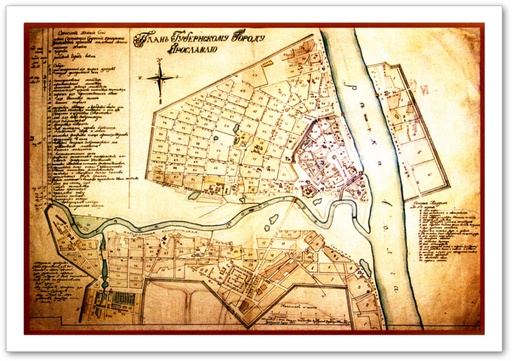 |
| dated of 2nd February 1809 -
click to enlarge |
|
|
 |
|
 |
|
YAROSLAV THE WISE
|
 |
|
prince of Rostov |
|
|
 |
|
 |
|
|
|
|
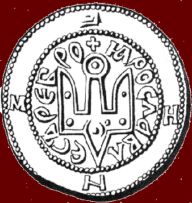
Piece of money
|
 |
|
dated
of XI century |
|
|
|
|
|
|



; popup.document.open();popup.document.write( '<html><head><link rel=\'stylesheet\' href=\'../_frame/site.css\' type=\'text/css\'></head><body style=\'background-color:#FFFFFF;background-image:url();\' bgcolor=#FFFFFF><center><img src=\'bv000001.jpg\'><br><br><table class=\'wg-paragraph\' style=\'border:none\'><tr><td><a href=\'javascript:close();\'>close</a></td></tr></table></center></body></html>' );popup.document.close(); "Cliquez pour agrandir l'image")
; popup.document.open();popup.document.write( '<html><head><link rel=\'stylesheet\' href=\'../_frame/site.css\' type=\'text/css\'></head><body style=\'background-color:#FFFFFF;background-image:url();\' bgcolor=#FFFFFF><center><a href=\'http://www.lauyan.com\' target=\'_top\'><img style=\'border:0px\' src=\'bv000002.jpg\'></a><br><br><table class=\'wg-paragraph\' style=\'border:none\'><tr><td><a href=\'javascript:close();\'>close</a></td></tr></table></center></body></html>' );popup.document.close(); "Cliquez pour agrandir l'image")